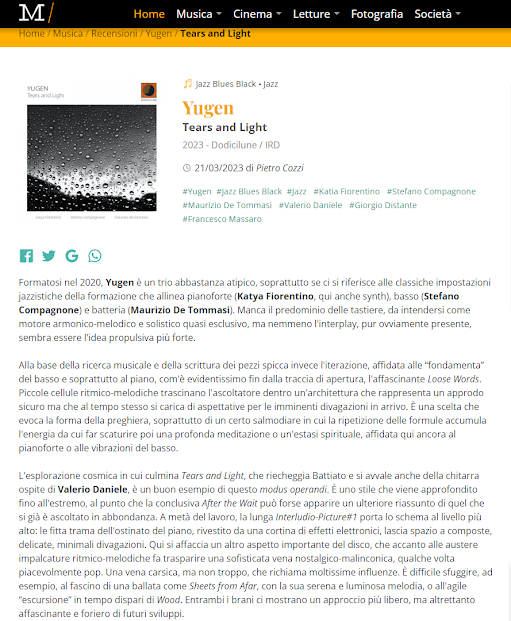
Review from February 21, 2023, on Mescalina.it by Pietro Cozzi.
Formed in 2020, Yugen is a rather atypical trio—especially when compared to classic jazz configurations—featuring piano (Katya Fiorentino, who also plays synth here), bass (Stefano Compagnone), and drums (Maurizio De Tommasi). The keyboard does not dominate as the near-exclusive harmonic, melodic, and soloistic engine; nor does interplay—while certainly present—seem to be the primary driving force.
Instead, the musical exploration and composition are grounded in iteration—driven by the bass “foundation” and, above all, the piano. This is immediately evident in the opening track, the captivating “Loose Words.” Small rhythmic-melodic motifs draw the listener into a structural framework that offers a sense of stability while simultaneously building anticipation for the impending musical excursions. This approach evokes the form of prayer—specifically a type of psalmody where the repetition of phrases accumulates energy, eventually giving rise to deep meditation or spiritual ecstasy, here channeled through the piano or the vibrations of the bass.
The cosmic exploration that marks the climax of “Tears and Light”—a track echoing Battiato and featuring guest guitarist Valerio Daniele—is a prime example of this *modus operandi*. This style is explored to the limit, to the point where the closing track, “After the Wait,” might almost seem like a recap of what has already been heard in abundance. Midway through the album, the lengthy “Interludio-Picture#1” takes this approach to its peak: the dense texture of the piano *ostinato*, veiled in a layer of electronic effects, gives way to poised, delicate, and minimalist excursions. Here, another important aspect of the album emerges: alongside its austere rhythmic and melodic frameworks, it reveals a sophisticated vein of nostalgia and melancholy—at times pleasantly pop-inflected. It is an undercurrent—though not an entirely hidden one—that draws upon a multitude of influences. It is hard, for instance, to resist the charm of a ballad like “Sheets from Afar,” with its serene, luminous melody, or the nimble odd-meter excursion of “Wood.” Both tracks showcase a freer approach—one that is equally captivating and holds promise for future developments.